
4 Tips for Sharing the Road with Emergency Vehicles
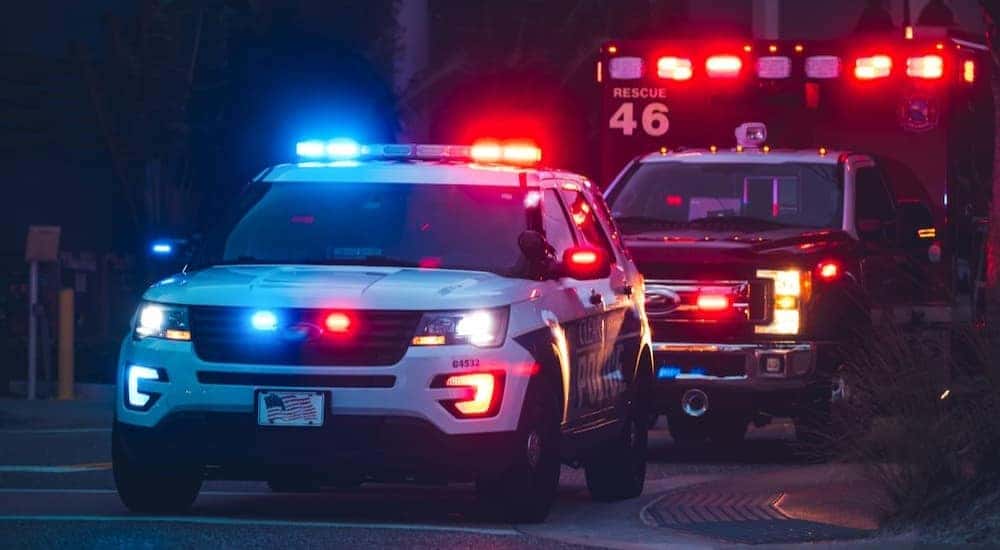
We have all been there…flashing lights and sirens wailing, and the rearview mirror showing a confusion of cars moving this way and that to clear a lane for an emergency vehicle on a serious mission. The question then becomes what to do. It seems straightforward, but too many times drivers are faced with an uncertain situation, such as an upcoming bridge, a narrow shoulder, or the chaotic reactions of fellow motorists to an oncoming emergency vehicle.
Right-of-Way
When faced with a situation requiring you to maneuver around an emergency vehicle, a simple rule to remember is that the emergency vehicle always has the right-of-way. Anything you do that in any way inhibits the vehicle from carrying on in its mission is illegal. The legal ramifications vary from state to state, but you could put yourself in a position to deal with traffic court and fines if you allow indecision to affect your response. Just remember, all other traffic rules go out the window. It always has the right-of-way, and it is your responsibility to make way for it to pass by without interference.
Being Overtaken
When you see an emergency vehicle approaching from behind, avoid the impulse to quickly maneuver out of the way. You could easily compound the trouble by hitting another vehicle, pedestrian, or unseen hazard on the road’s margin. Instead, take a second to make a plan, have a look around you, use turn signals to indicate your intentions, and move out of the way in a controlled fashion. Do not pull back into traffic until the vehicle has passed and you’ve made sure the way is clear and no other vehicles are following closely behind. Resist the urge to follow too close, as most states mandate a certain distance within which it is illegal to follow.
Oncoming
If you look up to see an emergency vehicle heading toward you from the opposite direction, you should prepare to move to the side of the road, even if it appears as though the vehicle has sufficient room. There is often a lot happening in the cab of a first responder vehicle. Since you don’t know their situation or their intent, the best course of action is to settle down, carefully move to the side, and then carry on safely once the vehicle has passed.
Passing
When you come upon an emergency vehicle on the side of the road, you should move as far away as possible and slow down considerably. In fact, it is the law. The particulars vary, but the common thread is that it is a driver’s responsibility to give as much room as possible and reduce speed. In some areas, the requirement is to slow your vehicle to under the speed limit.
There are, not surprisingly, a host of laws dealing with the correct way to deal with these situations, but they can be distilled into a few simple-to-remember rules that will help you the next time you encounter an emergency vehicle on the road.
0 comment(s) so far on 4 Tips for Sharing the Road with Emergency Vehicles